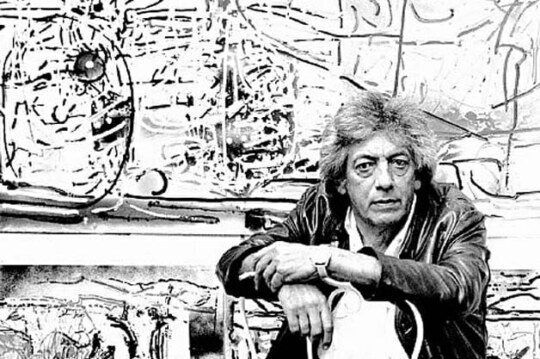

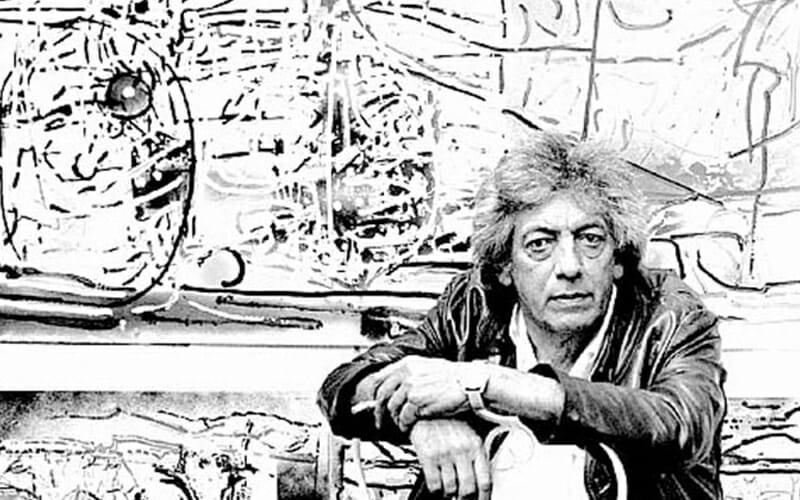
Born in Montréal in 1923, Riopelle is accomplished as an abstract painter, sculptor and graphic artist. Riopelle studied at L’ecole des Beaux-Arts, and with Henri Bisson at L’ecole du Meuble.
While still a student, he became integral to Québec’s emerging Automatistes school of painting, in which surrealistic painting techniques are used to express the patterns of the unconscious. Together with his life-long friend and colleague, photographer Maurice Perron, Riopelle was also a founding member of the revolutionary Refus Global, which challenged the traditional values of Québec’s post-war society.
In 1946, Riopelle moved to Paris, where he embraced the emerging Tachist movement and its spontaneous approach to abstract expressionism. Later in his career, Riopelle further refined his technique with his daring and imaginative use of white space to create an expansive effect. He also focused on the evolution of his sculpting talent, culminating with his masterpiece La joute, created for the site of the 1976 Montréal Olympics.
The list of citations, prizes and honorary degrees awarded to Jean-Paul Riopelle over the past six decades is long enough to fill a book. Highlights include his being awarded the 1958 Prix International Guggenheim and, in 1962, the coveted Unesco prize. In Canada, Riopelle’s many accolades include the 1973 Philippe Hébert Prize and, in 1975, induction as a Companion of the Order of Canada.