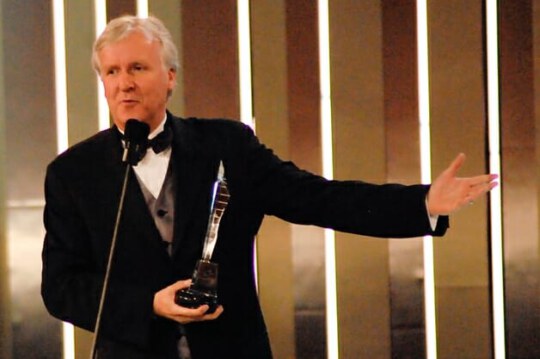



Growing up near Niagara Falls, Cameron was fascinated by the world around him. He read voraciously, particularly science fiction and fantasy, and loved Stanley Kubrick’s 2001: A Space Odyssey. When one of his favourite teachers decided to develop a theatre arts program, he dove into this project. The group of students formed their own independent production company, building props, scenery, the stage and costumes. He credits this experience with helping him develop his strong and independent work ethic.
When Cameron was 17, his father was offered a position at a company in California. Cameron took his love of building technical things, the arts, writing and science fiction, and enrolled at a local college to study physics. Conflicted about his direction in life, Cameron soon dropped out of college and began working as a machinist and truck driver.
The release of Star Wars led Cameron to realize what he truly wanted to do – tell stories through the medium of film. He began a course of self-directed study of the technology of special effects, optical printing, and front and rear projection. He took his small savings account and spent it on photography equipment and borrowed money to produce a short film.
His professional career began on Roger Corman’s Battle Beyond the Stars (1980), where he served as a production designer, matte artist and visual effects director of photography. When the production fell behind, Cameron asked Corman if he could second direct Galaxy of Terror (1981). “In the filmmaking business, no one ever gives you anything. Nobody ever taps you on the shoulder and says, you know, I admire the way you talk and the way you draw, and I think you’d made a good director.” But Cameron was now a director.
Cameron wrote three scripts in 1983: Rambo: First Blood Part 2; Aliens; and The Terminator, which he also directed. He directed Aliens (1986) and then wrote and directed The Abyss (1989). He wrote, produced and directed Terminator 2: Judgment Day (1991), True Lies (1994), and Titanic (1997).
In June 2005, Cameron was announced to be working on a project tentatively titled “Project 880” (now known to be Avatar) in parallel with another project, Battle Angel. Both movies were to be shot in 3D. By December, Cameron stated that he wanted to film Battle Angel first, followed by Avatar. However, in February 2006, he switched goals for the two film projects and decided to film Avatar first. He mentioned that if both films were successful, he would be interested in seeing a trilogy being made for both.
Avatar had an estimated budget of over $300 million and was released on December 18, 2009. This marked his first feature film since 1997’s Titanic. It is composed almost entirely of computer-generated animation, using a more advanced version of the “performance capture” technique used by director Robert Zemeckis in The Polar Express. James Cameron wrote an 80-page script for Avatar in 1995 and announced in 1996 that he would make the film after completing Titanic. In December 2006, Cameron explained that the delay in producing the film since the 1990s had been to wait until the technology necessary to create his project was advanced enough. The film was originally scheduled to be released in May 2009 but was pushed back to December 2009 to allow more time for post-production on the complex CGI and to give more time for theatres worldwide to install 3D projectors. Cameron originally intended Avatar to be 3D-only. The film went on to break the record for highest-grossing film ever, beating Cameron’s previous film Titanic. Avatar also became the first movie to ever earn more than $2 billion worldwide. It was nominated for nine Academy Awards, including Best Picture and Best Director, and won three for Best Cinematography, Best Visual Effects and Best Art Direction. Cameron lost the award for Best Director to his ex-wife, Kathryn Bigelow, who also took Best Picture with her film The Hurt Locker.